By 2 PM on a July afternoon in McLean, your beautiful screened porch has become a greenhouse. The thermometer reads 94°F, humidity hovers at 78%, and that western sun is blasting through the screens with enough UV intensity to fade your outdoor furniture in a single season. You built that porch addition to enjoy Northern Virginia’s gorgeous summers—not to watch it through your kitchen window while the AC runs overtime.
This is the specific challenge facing homeowners across Great Falls, Vienna, Oakton, and throughout Northern Virginia: screened porches that promise three-season living but deliver maybe six usable weeks. The problem isn’t your screens. It’s the uncontrolled solar heat gain that interior blinds and small-window solutions were never designed to address.
Why Northern Virginia Screened Porches Overheat
Northern Virginia’s climate creates a perfect storm for porch overheating. Average July temperatures reach 88°F with humidity levels averaging 70% (Source: National Weather Service Sterling Office, 2023). Unlike dry-heat regions where shade alone provides relief, our humid summers mean that trapped heat has nowhere to go—it just sits on your porch, making the space feel 10-15 degrees hotter than the actual air temperature.
The Colonial Porch Problem
The dominant architectural style in established Northern Virginia neighborhoods—Colonial and transitional homes—often features large screened porch additions on the rear or side of the home. These additions in communities near Wolf Trap and throughout Fairfax County typically have 8-12 foot ceiling heights and expansive screen panels designed to maximize airflow and views. Beautiful design, but it also maximizes solar heat gain.
According to the U.S. Department of Energy, unshaded windows and screen areas can account for up to 76% of summer heat gain in residential structures (Source: U.S. Department of Energy, Energy Saver Guide, 2022). Your screened porch, with its multiple large openings, essentially functions as a solar collector during peak afternoon hours.
Why Interior Solutions Fall Short
Interior roller shades, blinds, and curtains work by blocking light after it enters your space. The solar energy has already passed through your screens and begun heating the interior air. Studies show that exterior shading solutions block up to 90% of solar heat before it enters a structure, compared to only 45% for interior treatments (Source: Lawrence Berkeley National Laboratory, Windows and Daylighting Group, 2021).
For Northern Virginia homeowners paying Dominion Energy bills that spike every summer, this distinction matters. Exterior solar shades intercept UV rays and heat at the source, keeping your porch—and the adjacent rooms—significantly cooler.
How Exterior Solar Shades Transform Your Screened Porch
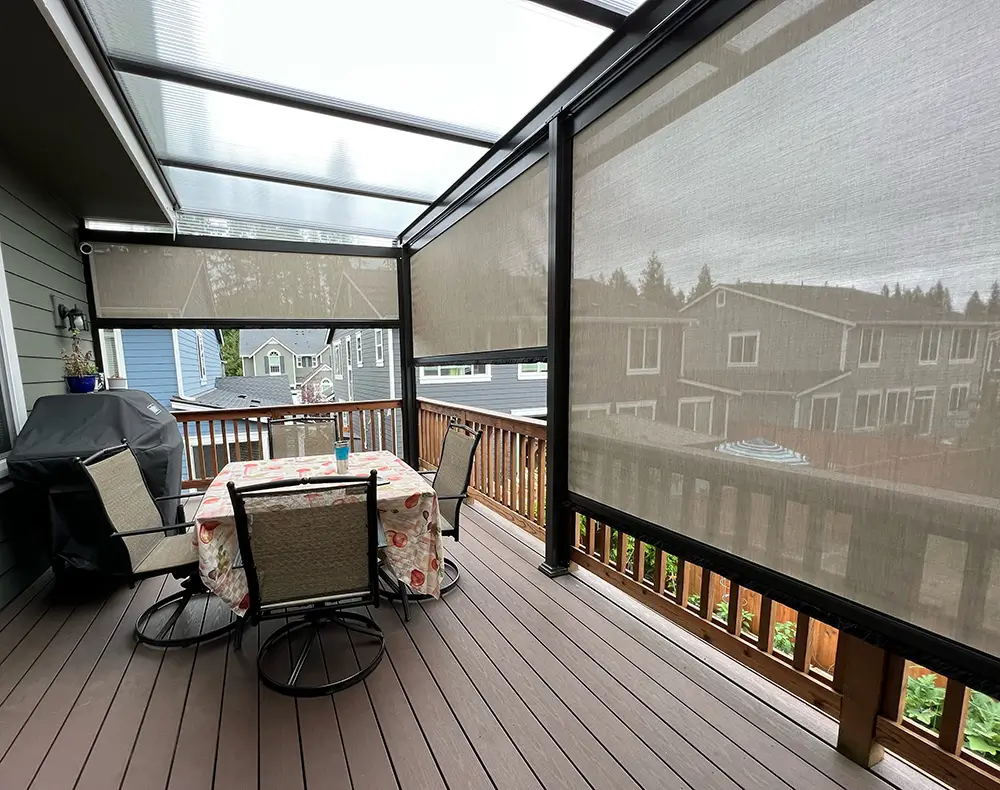
Exterior solar shades mount on the outside of your screened porch openings, creating a thermal barrier between the sun and your living space. Unlike awnings that block your view or pergolas that require permanent construction, motorized exterior shades retract completely when you want full sunshine and deploy instantly when afternoon heat arrives.
Temperature Reduction You Can Actually Feel
Properly installed exterior solar shades reduce screened porch temperatures by 15-25°F during peak sun hours (Source: ENERGY STAR, Shading and Cooling Strategies Technical Brief, 2023). In practical terms, this transforms a 100°F porch into an 80°F comfortable outdoor room where you can actually host that summer dinner party.
For homes in Vienna and Oakton, where mature tree canopies have been reduced by development, exterior shades restore the cooling effect that natural shade once provided.
UV Protection That Preserves Your Investment
Northern Virginia’s latitude receives intense UV radiation from May through September. Unprotected outdoor furniture, cushions, and flooring fade rapidly—the Skin Cancer Foundation reports that UV-A rays penetrate standard window screens at nearly full intensity (Source: Skin Cancer Foundation, UV Radiation and Your Skin, 2023). Exterior solar shade fabrics block 90-99% of harmful UV rays depending on openness factor, protecting both your family and your investment in porch furnishings.
Maintaining Airflow and Views
The key advantage of solar shade fabrics over solid awnings is their ability to reduce heat while preserving ventilation. Available in openness factors from 1% to 14%, these fabrics let you choose your balance between maximum UV protection and view-through clarity. Most Northern Virginia homeowners find 5% openness ideal—enough to see the backyard clearly while blocking the majority of solar heat.
| Openness Factor | UV Blockage | View Clarity | Best For |
|---|---|---|---|
| 1-3% | 97-99% | Limited | Maximum privacy, west-facing porches |
| 5% | 95% | Good | Most Northern Virginia applications |
| 10-14% | 86-90% | Excellent | Shaded porches, view preservation priority |
Choosing the Right System for Your Northern Virginia Home
Not all exterior solar shade systems perform equally in our mid-Atlantic climate. Northern Virginia’s weather throws everything at your porch—humid summers, driving rain, occasional ice storms, and winds that funnel through the Potomac corridor. Your shade system needs to handle all of it.
Motorization: Essential, Not Optional
Manual exterior shades require you to physically access each shade to raise or lower it. On a screened porch with 4-6 large openings, this becomes impractical quickly. Motorized systems with sun sensors deploy automatically when UV intensity reaches your preset threshold, ensuring your porch stays cool even when you’re not home—or when you’re enjoying an event at Reston Town Center and want to return to a comfortable space.
Modern motors connect to home automation systems, allowing voice control and scheduling. Integration with Dominion Energy‘s time-of-use rate programs lets you program shades to deploy during peak pricing hours (2-6 PM summer weekdays), reducing cooling costs for adjacent interior spaces.
Frame and Hardware Durability
Exterior installations face direct weather exposure. Look for:
- Powder-coated aluminum housings rated for coastal environments
- Stainless steel fasteners (not zinc-plated)
- Wind-rated side channels that prevent fabric flutter up to 25 mph
- Sealed motor housings with IP65 or higher ratings
Systems designed for interior use or occasional exterior mounting won’t survive Northern Virginia’s climate. Ask specifically about warranty coverage for exterior installations in humid environments.
Fabric Selection for Our Climate
Solar shade fabrics vary dramatically in quality and longevity. For Northern Virginia’s combination of humidity, UV intensity, and temperature swings, specify:
- Solution-dyed fiberglass or polyester core (color throughout, not surface-applied)
- Mildew-resistant coating (critical for our humidity)
- 10-year minimum UV stability warranty
- Cleanable surface that won’t trap pollen
Professional Insight: The cheapest exterior shade fabrics often come from manufacturers without mid-Atlantic climate testing. We’ve seen budget fabrics degrade within 3 years in Northern Virginia conditions, while premium fabrics maintain appearance and function for 15+ years. Your screened porch is a significant investment—protect it with materials engineered for your actual environment.
Installation Considerations for Screened Porch Structures
Screened porches present unique installation requirements that differ from standard window applications. The structure must support exterior-mounted hardware without compromising the screen frames or roof attachment points.
Structural Assessment
Older screened porches in Great Falls and established Northern Virginia neighborhoods may have wooden frames that require reinforcement before mounting motorized shade systems. A qualified installer will assess your porch’s load-bearing capacity and recommend any necessary upgrades before installation.
Electrical Requirements
Motorized exterior shades require dedicated electrical circuits or hardwired low-voltage connections. Battery-operated systems exist but require frequent recharging and lack the power for consistent deployment in larger installations. Professional installation includes routing power to each shade location in compliance with Fairfax County electrical codes.
Mounting Options
Depending on your porch architecture, exterior solar shades can mount:
- Fascia mount: Attached to the horizontal trim below the roofline—most common for Colonial-style porches
- Soffit mount: Recessed into the underside of the roof overhang—cleaner appearance, requires adequate soffit depth
- Ceiling mount: Direct attachment to porch ceiling—used when fascia or soffit mounting isn’t possible
Each approach has aesthetic and functional implications. A site assessment determines which option best suits your specific porch structure and your preference for visible versus concealed hardware.
What to Expect: Investment and Return
Exterior solar shade systems for screened porches represent a significant investment—typically $800-2,500 per opening depending on size, fabric selection, and motorization features. A typical Northern Virginia screened porch with 4-6 openings runs $4,000-12,000 fully installed.
Value Beyond Comfort
The National Association of Home Builders reports that outdoor living improvements return 65-90% of their cost at resale in mid-Atlantic markets (Source: National Association of Home Builders, Remodeling Impact Report, 2022). More importantly, exterior solar shades transform an underused space into functional square footage you actually enjoy—extending your usable outdoor season from June-only to April through October.
Energy Savings
Screened porches adjacent to air-conditioned spaces create heat transfer through shared walls and doors. By reducing porch temperatures 15-25°F, exterior shades reduce cooling loads for interior rooms. Homeowners with porches on the west or south side of their homes report the most dramatic energy savings—some noting 10-15% reductions in summer Dominion Energy bills after installation.
Ready to transform your screened porch from a seasonal disappointment into Northern Virginia’s best outdoor room? Schedule your free screened porch shade consultation today and get a custom assessment for your specific porch dimensions, orientation, and architectural style.
Frequently Asked Questions
Can exterior solar shades withstand Northern Virginia storms?
Quality exterior shade systems designed for our climate include wind sensors that automatically retract shades when gusts exceed safe thresholds—typically 20-25 mph. Side-channel track systems prevent fabric flutter in moderate winds, and motor housings carry IP65+ ratings for rain protection. We recommend retracting shades during severe thunderstorm warnings common to the Tysons Corner area during summer months.
How do I clean exterior solar shades in Northern Virginia’s pollen season?
Exterior solar shade fabrics handle our notorious spring pollen better than you might expect. Most fabrics simply require hosing off with water every few weeks during peak pollen season—no special cleaners needed. For stubborn buildup, mild soap and a soft brush remove residue without damaging the UV-protective coating. Avoid pressure washers, which can stretch the fabric.
Will exterior shades darken my porch too much?
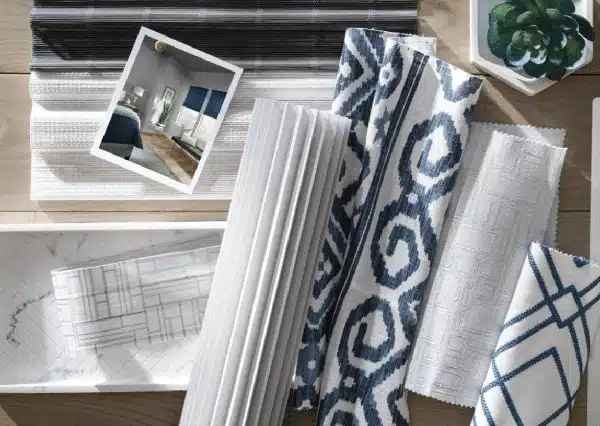
Fabric openness factor determines light transmission. A 5% openness fabric blocks 95% of UV while allowing comfortable ambient light—similar to wearing quality sunglasses. For porches already shaded by trees or northern exposures, higher openness factors (10-14%) provide UV protection while maximizing natural light. We bring fabric samples during consultations so you can see exactly how each option affects your specific porch.
Don’t spend another Northern Virginia summer watching your porch sit empty during the best weather. Get your free consultation and discover how exterior solar shades make your screened porch the comfortable, bug-free retreat you imagined when you built it.
Frequently Asked Questions
Can exterior solar shades withstand Northern Virginia storms?
Quality exterior shade systems designed for our climate include wind sensors that automatically retract shades when gusts exceed safe thresholds—typically 20-25 mph. Side-channel track systems prevent fabric flutter in moderate winds, and motor housings carry IP65+ ratings for rain protection. We recommend retracting shades during severe thunderstorm warnings common to the Tysons Corner area during summer months.
How do I clean exterior solar shades in Northern Virginia’s pollen season?
Exterior solar shade fabrics handle our notorious spring pollen better than you might expect. Most fabrics simply require hosing off with water every few weeks during peak pollen season—no special cleaners needed. For stubborn buildup, mild soap and a soft brush remove residue without damaging the UV-protective coating. Avoid pressure washers, which can stretch the fabric.
Will exterior shades darken my porch too much?
Fabric openness factor determines light transmission. A 5% openness fabric blocks 95% of UV while allowing comfortable ambient light—similar to wearing quality sunglasses. For porches already shaded by trees or northern exposures, higher openness factors (10-14%) provide UV protection while maximizing natural light. We bring fabric samples during consultations so you can see exactly how each option affects your specific porch.
How long does installation take for a typical Northern Virginia screened porch?
Most screened porch exterior shade installations complete in one day for 4-6 openings, assuming no structural modifications are needed. The process includes final measurements, mounting hardware installation, shade hanging, motor programming, and homeowner training on controls. Porches requiring electrical work or structural reinforcement may need a preliminary visit before the main installation date.